
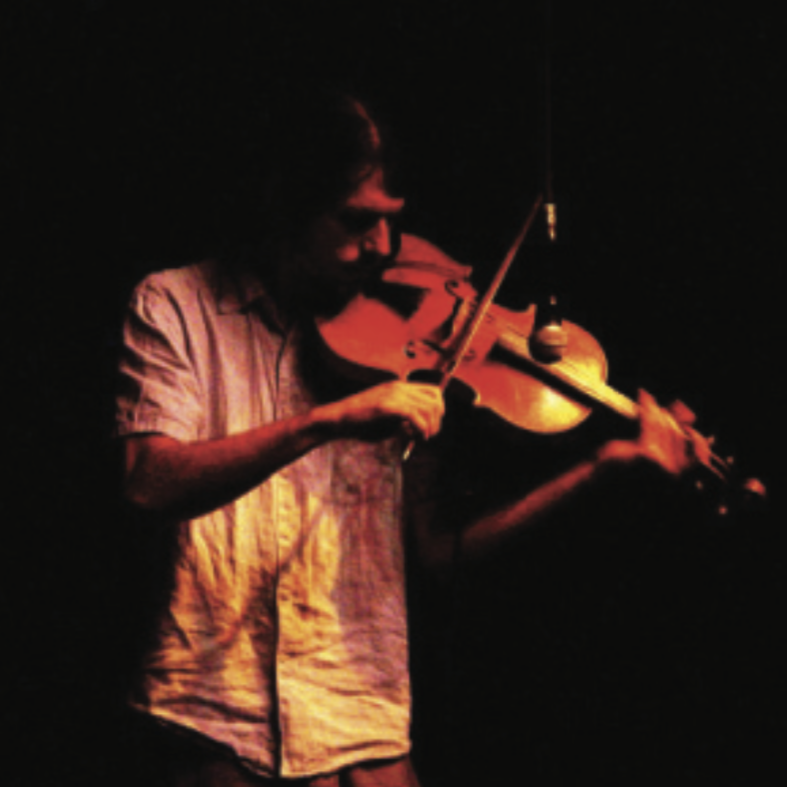
René Peñaloza Galván*
Writing about what has come to be called ‘noise music’ is a particularly slippery undertaking, its parameters are so elusive there’s not much to grab on to. The term itself seems, in a way, oxymoronic: the torturous character of ‘noise’ grinding against the pleasurable virtues of ‘music.’ noise Music is a particularly nonlinear experience: there’s no neatly laid out grid of verses and choruses, of motifs and instrumentations, not even a horizon to gaze wistfully towards (though if you hate the stuff I suppose the exit would be your horizon). Really, the only steadfast signals of structure are the starting and the stopping of the music: noise short-circuits the narrative trinity of beginning-middle-end. A performance of ‘noise music’ can feel like a spirit massaging your insides or a kick to the stomach. It can lead to disquisitions on the nature of art or to unabashed dismissal. It’s makers can be music composition PhDs or metal heads pushing the envelope or anything else.
I confess to being one who enjoys the full spectrum of noise: barely audible crackles, se- dately-building drones, dense slabs of mono- lithic tumult. Defining the pleasures of sitting down and listening to three hours of what can seem like everything and nothing all at once––i.e. purest nonsense––can prove difficult. Is it possible to talk about the ‘aesthet- ics’ of noise Music? (Can, or should you, do that to something that is essentially an anti- aesthetic?). Or maybe it should be a clear conceptual rendering of the subversive act of treating ‘noise’ as ‘music’? (Certainly neater, but totally alien to the vital physical/ raw-sen- sory component).
My first noise epiphany came in the late nineties, during a concert by the british electronic duo Autechre. Though I was a keen follower of their recorded output, none of it really prefigured the sheer physicality of the group’s live performance. Instead of offering recognizable tracks, they presented an hour plus expanse of dense sonic architecture, truly pushed the concert-going experience to the point of rendering it spatially tactile and tetra-dimensional (three spatial dimensions evolving over time). standing amidst a capacity crowd of beguiled true believers I could feel the cavernous space of the venue being reconfigured by steely sheets of sound that felt like they were unfolding fractally all around us.
We weren’t listening to the music so much as inhabiting it, zoning in on tightly pleated crevices or letting darting microscopic slates of gleaming sonority wash over us. Thus, I came to believe that experiencing noise in a live setting was essential to apprehending the full mind fuck potential of noise presented as music––more on this later.
The closest thing to a touchstone in a realm that fundamentally abhors ‘master- works’ might just be Lou Reed’s 1975 affront of an album Metal Machine Music. The basic notion of noise Music had been pioneered half a century earlier by the Futurist Russolo brothers and fostered within an academic context by contemporary composers from Edgard Varèse to Karlheinz stock- hausen.1 Yet the former Velvet Underground front man’s work on major music label RCA was really what introduced the whole concept of ‘noise music’ to a broader, less specialized audience by adding rock and roll’s rebel- next-door appeal for good measure. As much high-modernist praxis as post-modernist prank, MMM is one the most polyvalent offer- ings in the history of recorded music. Lester bangs called it such:
When you wake up in the morning with the worst hangover of your life, Metal Machine Mu- sic is the best medicine. because when you first arise you’re probably so fucked (i.e., still drunk) that is doesn’t even really hurt yet (not like it’s going to), so you should put this album on immediately, not only to clear all the crap out of your head, but to prepare you for what’s in store the rest of the day. […] I realize that any idiot with the equipment could have made this album, including me, you or Lou. That’s one of the main reasons I like it so much… It’s all folk music, anyway. Brian Eno considered the album part of “the roots of ambient.” For him, Lou Reed’s sonic assault constituted the complimentary end of the ‘music-as-immersion’ axis. (Eno himself was simultaneously pioneering through his minimalist forays into textural music.2) The music press didn’t know what to make of it, and at some point Reed claimed he himself had never heard his own work all the way through, and unveiled the tricksterish side to the whole endeavor. Oddly enough (as if they’d never remotely heard of Duchamp’s 1917 urinal-upended-into-Fountain), most music writers outside of bangs and a few exceptions felt compelled to either damn it as meaningless whim, or praise it as visionary masterpiece, unwilling to consider it both. MMM showed how noise music’s dissonant directive could spill over from the cauldron of the sensory onto the checkered tile floor of the cerebral, generating interference between all the different––and equally valid––manners in which it can be thought about. The album has come to represent a paradigm of sorts: an unwavering commitment to abstraction, insolent ambivalence and pervasive standoffishness, which could even be construed as macho. not the oppressive kind of macho that must constantly assert itself, but rather the one found in Jean-Luc Godard’s Pierrot le fou, who committed suicide by painting his face blue and setting-off a crown of dynamite.3
Reed and Eno’s divergent forays into son- ic abstraction constitute ad hoc bookends for noise music’s ‘ends against the middle’ assault on the traditional hierarchies of western composition. One subverts conventional notions of musical meaning through over-satu- ration, while the other distills organized sound to its most microscopic expression in both intensity and structure. This sui generis duality is consummately expressed in John Cage’s renown 4’33” from 1973, where a lone piano remains silent and cedes the stage to the ambient noises of the venue at the moment. In offering the listener a whole lot of nothing, Cage synthesizes the meeting of extremes at the heart of the noise experience.
noise and language/ meaning share an asymptotic relationship.4 Music, like math, is organized as a self-contained language: noise is the Dadaistic explosion of that language, the breakdown of a figurative system in favor of abstraction and chance. Any attempt at creating a strict notation for noise music is necessarily a conceptual exercise (like John Cage’s sets of instructions). noise exists on the margins of language––in computer science it is thought of as data without mean- ingcircumventing any linear readings. Even at its tamest, the form refuses to have much to do with the staff and notes regime of ‘classical’ western notation.
Every instance of ‘noise Music’ is housed within some form of a sturdy conceptual framework, if only by virtue of it being con- textualized as such. Many works’ actual sub- stance is contained within the ideas behind them––reading about Yasunao Tone’s experi- ments with scuffed skipping CDs is certainly more crucial than actually listening to them. Yet despite all it’s conceptual gravitas, noise really operates on the lawless margins of lan- guage, where terminology is infinitely ductile and any attempt at verbalizing the experience is usually subject to the kind of uncertainty associated with quantum mechanics.5 That is, the more you focus on the conceptual framework of the piece, the more you stray from the raw––and equally crucial––sensory component.
‘noise’ comes from the Latin ‘nausea,’ fitting in how it overtakes unwary ears with a dense, and relentless lack of meaning, much like Frank stella’s ‘black paintings’ challenge you to find something to look at, a challenge which routinely offers plenty rewards to the adequately obsessed spectator. In the ‘sound for sounds sake’ approach of noise music, the medium annihilates the message. The practice is fundamentally defined by its lacks––if you can hum it on your way back from the show chances are it wasn’t noise––remitting all stable signifiers to the realm of the purely conceptual. Though this is not altogether accurate considering that noise absolutely muddles up the structuralist binarchy of form and content: What is really the content of a form where meaning is not contained but conceived before and after the fact? One could even go far enough to assert that all noise art is conceptual in so far as it involves the framing of unregimented sound as music. Yet one would certainly be refuted at some point, because consummate transgressive practice that it is, noise making manages to routinely squirm through the loopholes in any generalization you try to saddle it with.
Thus, noise Music has constituted itself as the alpha and the omega of musical art. It har- kens to a prelinguistic stage, while delivering on Luigi Russolo’s dream of a sound art that incorporated the pervasive machine noises of industrialized modern society. noise’s perva- sive nonlinearity is good to feel and good to think, which is why the emergence of Casa Vecina as a reliable noise venue has been so valuable in a city that oozes noise from all its pores, yet seldom treats it as music––one gets the sense that as an animated sprawl of cacophonic accretions, Mexico City has always been crying out for a more purposeful approach to chaos and silence.
A nuanced appreciation of noise music is very much contingent on having access to ad hoc venues where one can experience its birth pangs and death throes first hand on a regular basis. There is a strong element of ritual in a live noise performance: a group of people gathered expressly to focus their attentions on what would normally be deemed detritus were it not framed as music. This phenomenon can border on the monastic in venues like John Zorn’s new York sound temple The stone, where no form of refreshments or merchandise are allowed in an effort to underscore utmost audience decorum. The fact that people willingly submit themselves to noise as an artistic practice is certainly absurd on several levels, but it is also an act of the utmost integrity, almost faithful and pious, as well as one of the last truly revolutionary acts in a time increasingly devoid of them.6
The opening of downtown Mexico City’s Casa Vecina in late 2005 has come to represent a substantial step in the emergence of a solid noise scene in the capital. After being thinly spread out over a series of one-off concerts and annual festivals throughout the city’s galleries and museums, DFs noise musicians finally had a place where they could engage in sustained dialogue. True, places such as X- Teresa, Arte Alameda, the Rufino Tamayo and a cluster of true-believer-operated cultural spaces held the Mexican scene together, but they were in dire need of back-up.
The possibility of building an audience to follow their sonic excursions thus became a real possibility for Chilango noise- makers. Meanwhile, that potential audience was also given the opportunity to experience noisemaking first-hand and reach their own conclusions about projects as ostensibly appealing as Trementina, which resulted from a marriage between two string musicians from the national symphonic Orchestra and mainstays of Mexican noise Music, as well as the more challenging efforts of .pig, Rogelio sosa’s scatological blitz of raw ‘chapopote‘ sonorities, which have garnered the admirations of palettes as demanding as those at the sub-Rosa label.
There are also the collaborative efforts of dorkbot, the audiovisual prowess of Orquesta silenciosa with their improvisations over evanescent super 8 frescoes, the nano-crafting of the artists that make up the Mandorla music label, and a public street performance by ostensibly digestible veteran experimenters nine Rain, as well activities related to poetry, performance and other artistic practices beyond the myopic scope of more orthodox cul- tural institutions.
It might be a stretch to expound that noise Music can only be fully understood within a live experience, or even that it should be understood at all, but a place like DF’s Casa Vecina takes upon itself the burden of making sure that one day people speak in hushed tones about watching someone stab a speaker with a light-saber dildo––or what sonically amounted to it–– somewhere on Regina street. And that can only be a good thing.
New York, 2008
* Musician, filmmaker and screenwriter (1962-2010).
1 With melody and harmony being the key figurative elements in the European tradition of composition, noise-making emerged as a principal strategy in furthering the modernist agenda of ‘sound for sound’s sake.’
2 Coincidentally enough, Eno’s first ambient offering, Discreet Music, came out the same week. Evidence that recorded music had reached a crux where the only clear options were Reed’s maximalist onslaught or Eno’s infinitesimal approach. 3 noise-making is perhaps the most male-dominated realm in music, the bullfighting of the medium. And while the whole idea of a sonic pummel is macho indeed, noise shows are markedly low testosterone affairs: their audiences are not there to show-off their venting, but to take in something that departs radically from the norm, and usually represents a paragon of openess and tolerance.
4 Asymptotes as expressed in Calculus are lines, which come ever so close to touching, but never quite do, even when stretched to infinity.
5 Heisenberg’s Uncertainty Principle is a basic tenet of Quantum Physics, which at its most basic expression states that the precision with which one can measure a particle’s ‘position’ is inversely proportional to that with which one can measure its ‘speed.’ In other words, there is no such thing as an ‘objective’ observer, because any act of observation necessarily alters the state of the particle being observed.
6 bangs also said of MMM: “As a statement it’s great, as a giant FUCK YOU it shows integrity—a sick, twisted, dunced- out, malevolent, perverted, psychopathic integrity, but integrity nevertheless.”
LIBRO: identidad provisional: primera entrega
Identidad provisional: primera entrega / Provisional identity: first delivery Primera edición / First edition 2011 D.R. © Fundación del Centro Histórico de la Ciudad de México A.C. / Casa Vecina Publicaciones 1er. Callejón de Mesones 7, Centro Histórico, 06080 Ciudad de México + (52 55) 5709.1540 www.casavecina.com